
Project Hexa: Modular Hexapod Research Platform for Terrain-Adaptive Autonomy
Active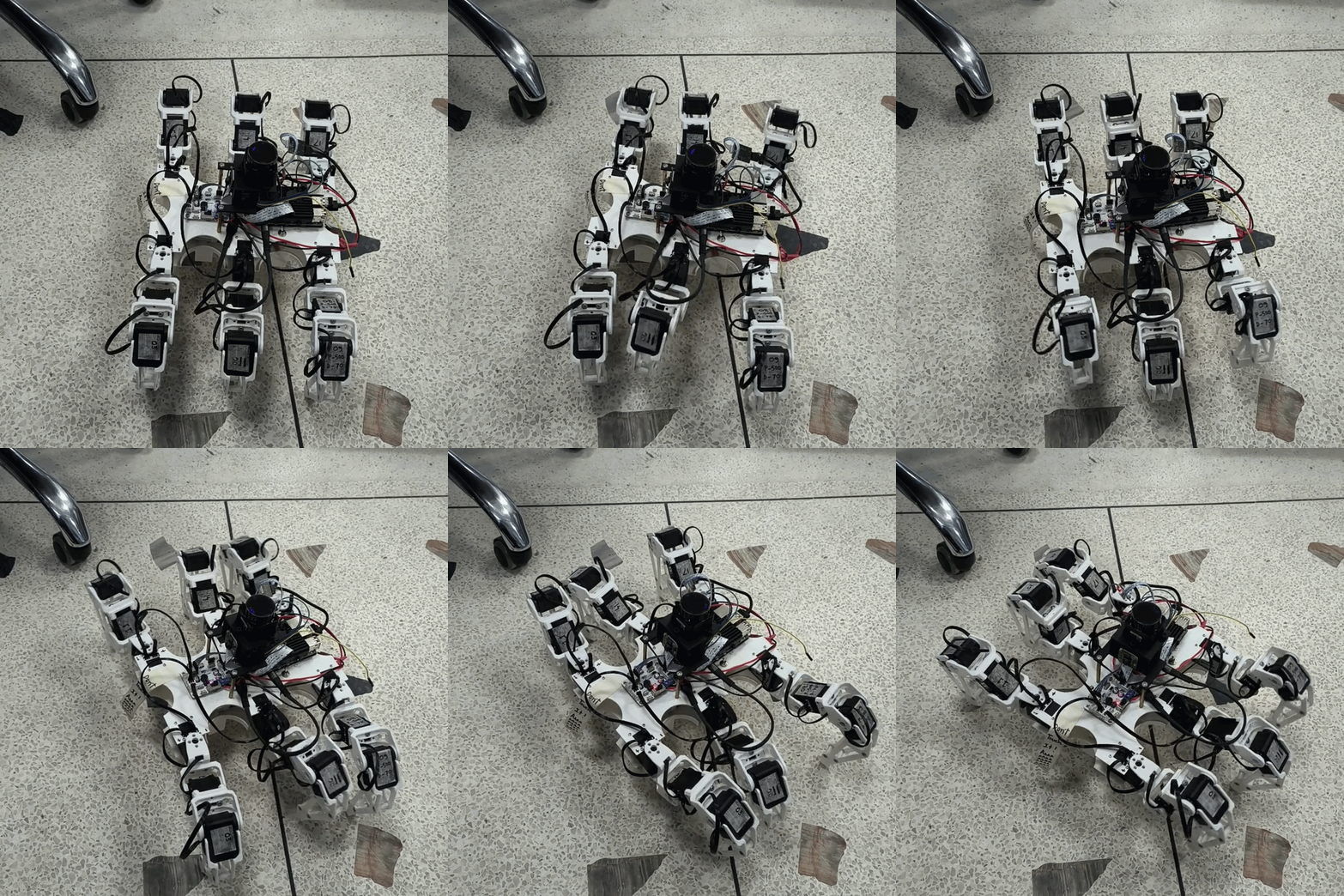
Overview
Wheeled robotics platforms face fundamental limitations when navigating unstructured terrain. While effective on flat surfaces, wheeled systems lose traction, stability, and maneuverability across irregular ground conditions that characterize real-world environments. This constraint restricts deployment scenarios for autonomous systems in search and rescue, agricultural inspection, environmental monitoring, and disaster response applications where terrain adaptability becomes critical for operational success.
Project Hex addresses these limitations through bio-inspired hexapod locomotion. The six-legged configuration with three degrees of freedom per leg delivers superior stability and terrain adaptation compared to wheeled alternatives. Powered by 18 high-torque servos coordinated through Arduino microcontroller architecture, the platform achieves dynamic gait generation and obstacle traversal capabilities. The LiPo battery system provides sustained operation while maintaining power efficiency across varied locomotion patterns.
The modular design framework supports progressive capability expansion. Standardized interfaces enable integration of Raspberry Pi computational modules, LiDAR ranging systems, and depth sensors for autonomous navigation and environmental mapping. This extensibility transforms the base hexapod into a research platform for exploring legged robot autonomy, terrain-adaptive control algorithms, and sensor fusion techniques in challenging operational contexts.
Objectives
- Design and fabricate a stable hexapod platform with 18-servo articulation providing adaptive locomotion across unstructured terrain where wheeled systems fail
- Develop coordinated gait control algorithms enabling dynamic terrain adaptation, obstacle navigation, and stable mobility under varied ground conditions
- Establish modular hardware architecture supporting integration of advanced sensing and computational components for autonomous navigation capability expansion
- Create an accessible research platform for investigating legged robotics, terrain-adaptive control strategies, and multi-sensor fusion in challenging environmental contexts
Methodology
Project Hex employs bio-inspired hexapod kinematics with servo-based articulation for each three-degree-of-freedom leg assembly. The control architecture coordinates 18 high-torque servos through microcontroller-based gait generation algorithms, enabling dynamic locomotion patterns adapted to terrain conditions. Hardware integration emphasizes power efficiency and mechanical stability through optimized servo placement and battery management systems.
The locomotion framework implements coordinated leg movements through inverse kinematics and gait planning algorithms. Servo control sequences generate walking patterns that maintain static and dynamic stability across varied terrain profiles. The modular architecture preserves extensibility through standardized communication protocols and mounting interfaces for computational upgrades and sensor additions.
Development follows iterative validation cycles combining mechanical testing with control algorithm refinement. The platform design prioritizes terrain adaptability while maintaining pathways for autonomous capability integration including simultaneous localization and mapping, environmental perception, and adaptive gait optimization based on real-time sensor feedback.
Current Progress
- Hexapod mechanical structure completed with 18 servo integration and power distribution system validated for sustained operation
- Arduino-based control framework operational, implementing basic gait patterns and coordinated leg movements for stable locomotion
- Modular interface specifications defined for Raspberry Pi, LiDAR, and depth sensor integration supporting autonomous navigation development roadmap
- Initial terrain adaptation testing underway to validate stability performance and refine gait algorithms for unstructured ground conditions