
NIRO Educational Bot: An Affordable Modular Robotics Platform
Active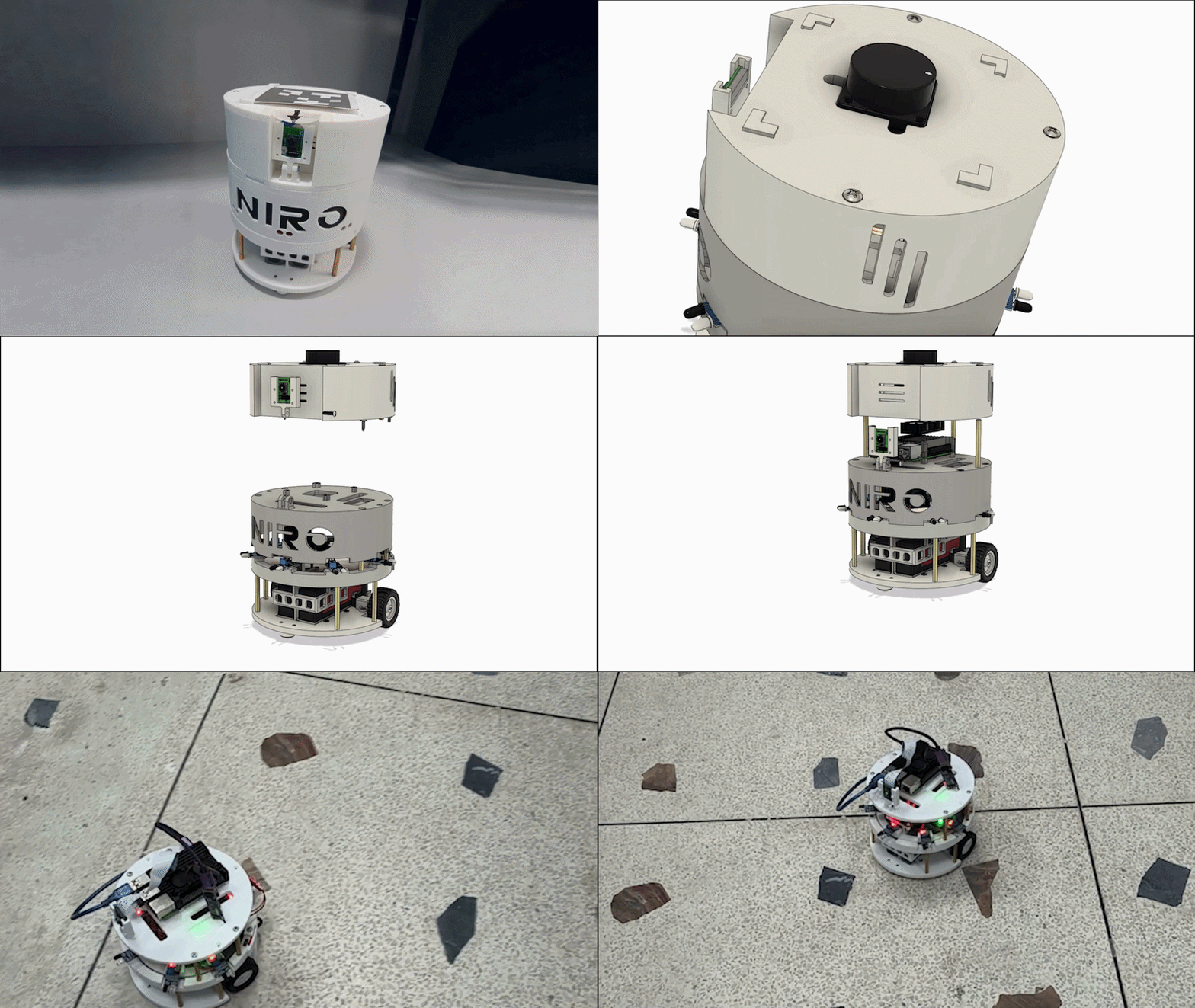
Overview
Robotics education in Bangladesh faces a critical accessibility barrier. Quality educational robotics kits cost between $200-500, placing them beyond reach for most students and educational institutions in developing markets. This cost barrier prevents hands-on STEM learning at scale, limiting the pipeline of skilled robotics engineers needed for Bangladesh’s Industry 4.0 transition. While robotics literacy becomes increasingly essential for future workforce readiness, the tools to build that literacy remain inaccessible to the majority.
NIRO Educational Bot addresses this challenge through contextual innovation. The platform delivers a fully functional, modular robotics system at a fraction of traditional costs through strategic design choices: 3D-printed chassis, PCB-based architecture, and open-source software. The differential drive system integrates Arduino microcontrollers with gyroscopes, IR sensors, ultrasonic sensors, and WiFi capabilities, enabling autonomous functions like obstacle avoidance and line following. The modular design supports progressive learning, allowing students to start with basic operations and advance to complex integrations including Raspberry Pi, LiDAR, and depth cameras.
This project directly supports UN SDG goals for accessible STEM education while building Bangladesh’s robotics engineering capacity. By making hands-on robotics learning affordable and scalable, NIRO creates pathways for students who would otherwise never engage with robotics technology. The open-source approach ensures knowledge transfer beyond individual users, fostering a community-driven ecosystem that can adapt and evolve with local educational needs. NIRO represents more than an educational tool—it’s infrastructure for democratizing technical literacy in emerging economies.
Objectives
- Develop an affordable, modular educational robotics platform priced significantly below existing market alternatives to enable widespread adoption in resource-constrained educational settings
- Create comprehensive open-source documentation and learning materials that empower students to progress from basic robot operation to advanced autonomous systems integration
- Establish a scalable platform architecture supporting progressive hardware expansion from entry-level sensors to advanced components including LiDAR, depth cameras, and Raspberry Pi integration
- Democratize hands-on robotics education across Bangladesh’s educational ecosystem, building technical capacity aligned with Industry 4.0 workforce requirements and UN SDG goals for accessible STEM learning
Methodology
NIRO employs a modular hardware-software integration approach centered on differential drive robotics architecture. The platform combines embedded systems programming with sensor fusion techniques to enable autonomous navigation and environmental interaction. Development follows an iterative prototyping methodology, utilizing rapid fabrication through 3D printing and custom PCB design to achieve cost optimization without compromising functional capability.
The software framework leverages microcontroller programming for real-time sensor processing and motor control algorithms. Core autonomous functions including obstacle detection, path planning, and line following are implemented through systematic integration of gyroscopic stabilization, infrared proximity sensing, and ultrasonic ranging. The architecture maintains extensibility through standardized interfaces that support progressive complexity scaling from basic operations to advanced machine learning integration.
Documentation and knowledge transfer follow open-source principles, ensuring reproducibility and community-driven refinement. The design philosophy prioritizes accessibility for novice users while maintaining pathways for advanced experimentation, creating a learning trajectory that mirrors real-world robotics engineering workflows from fundamental concepts to sophisticated autonomous systems.
Current Progress
- Core hardware architecture finalized with integrated differential drive system, sensor suite (gyroscope, IR, ultrasonic), and microcontroller framework supporting autonomous navigation functions
- Functional prototypes demonstrate obstacle avoidance, line following, and wireless connectivity capabilities with validated PCB-based design reducing manufacturing complexity
- Comprehensive technical documentation and presentation materials in development for broader institutional recognition and potential funding opportunities
- Advanced integration modules including Raspberry Pi compatibility and expanded sensor capabilities positioned for next-phase implementation following initial platform validation